
Educational resource · U.S. & Canadian data
The Data Behind Every Safe Renovation.
An asbestos survey protects people only if the record it leaves behind can be produced and trusted — in the United States or in Canada. This page sets out what regulators and researchers in both countries have documented about exposure, disease, and the paperwork that connects them.
Written for environmental consultants, inspectors, and facility managers.
Section 01
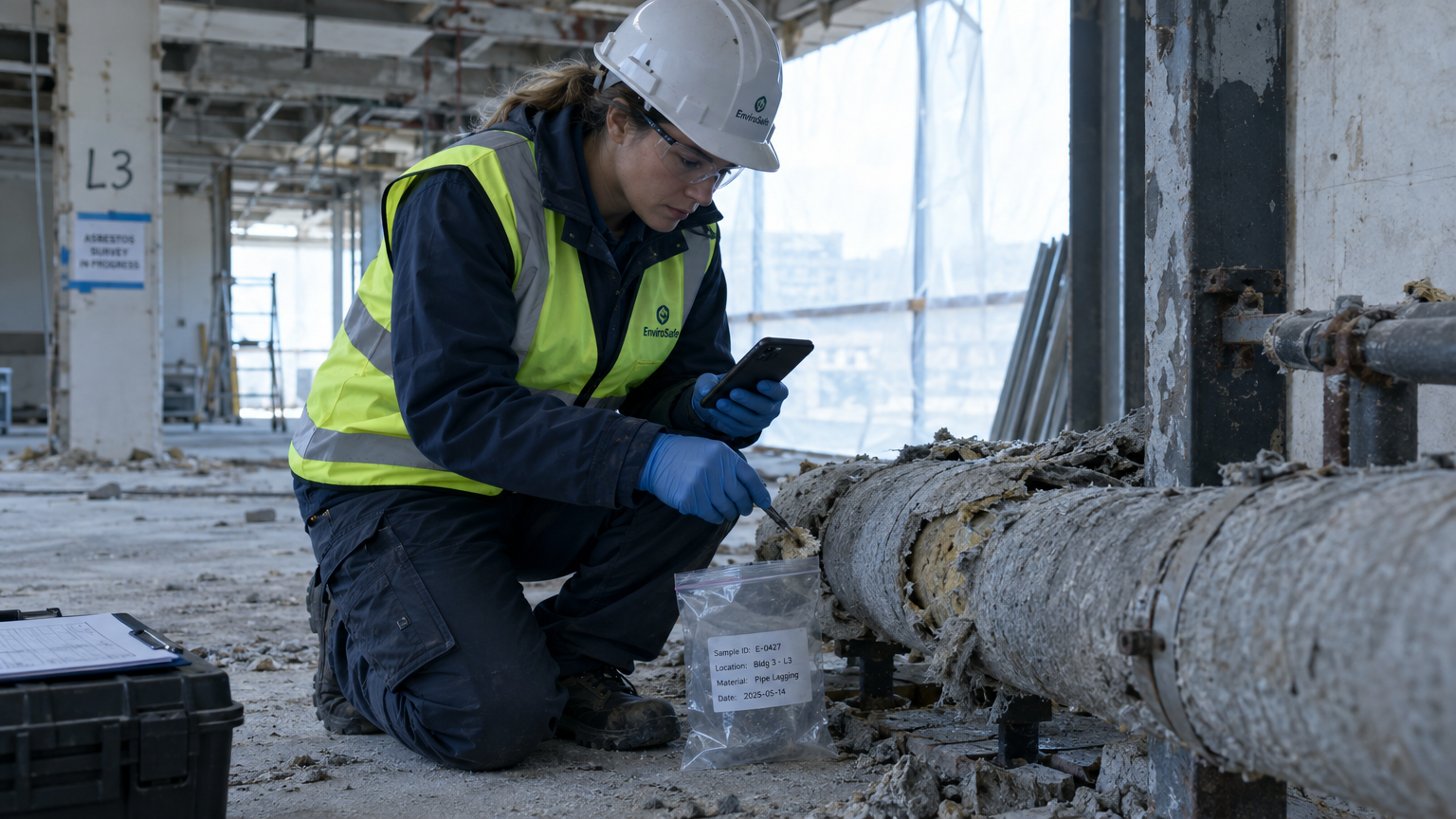
The Scale of Ongoing Exposure
Asbestos is often discussed in the past tense. The exposure data says otherwise — on both sides of the border.
workers potentially still exposed today
An estimated 1.3 million construction and general industry workers in the U.S. are potentially still being exposed to asbestos today, according to CDC's National Institute for Occupational Safety and Health (NIOSH).
Source: CDC's National Institute for Occupational Safety and Health (NIOSH)
workers currently exposed to asbestos
CAREX Canada, via the Occupational Cancer Research Centre, estimates approximately 152,000 workers are currently exposed to asbestos in Canada.
Source: CAREX Canada, via the Occupational Cancer Research Centre
The two countries track exposure through different surveillance programs, so the figures are not directly comparable. The direction, however, is the same on both sides of the border: asbestos in existing buildings and equipment is a live occupational exposure, not a historical one.
Section 02
Why There's No Safe Level
Decades of evidence on both sides of the border, and one shared conclusion.
According to OSHA, the heaviest asbestos exposures now occur during renovation, repair, and demolition — the disturbance of materials installed decades ago — rather than during new construction. The risk has effectively moved from manufacturing into the maintenance of the existing building stock.
OSHA's position is unambiguous: there is no safe level of asbestos exposure for any fiber type, and exposures as short as a few days have caused mesothelioma in documented cases. Both countries' regulators have acted on that same conclusion.
OSHA permissible exposure limit (PEL), 1971 → today
A reduction of more than 100-fold across five decades, according to OSHA's rulemaking record.
fibers per cubic centimeter (f/cc) — bar heights on a square-root scale for readability
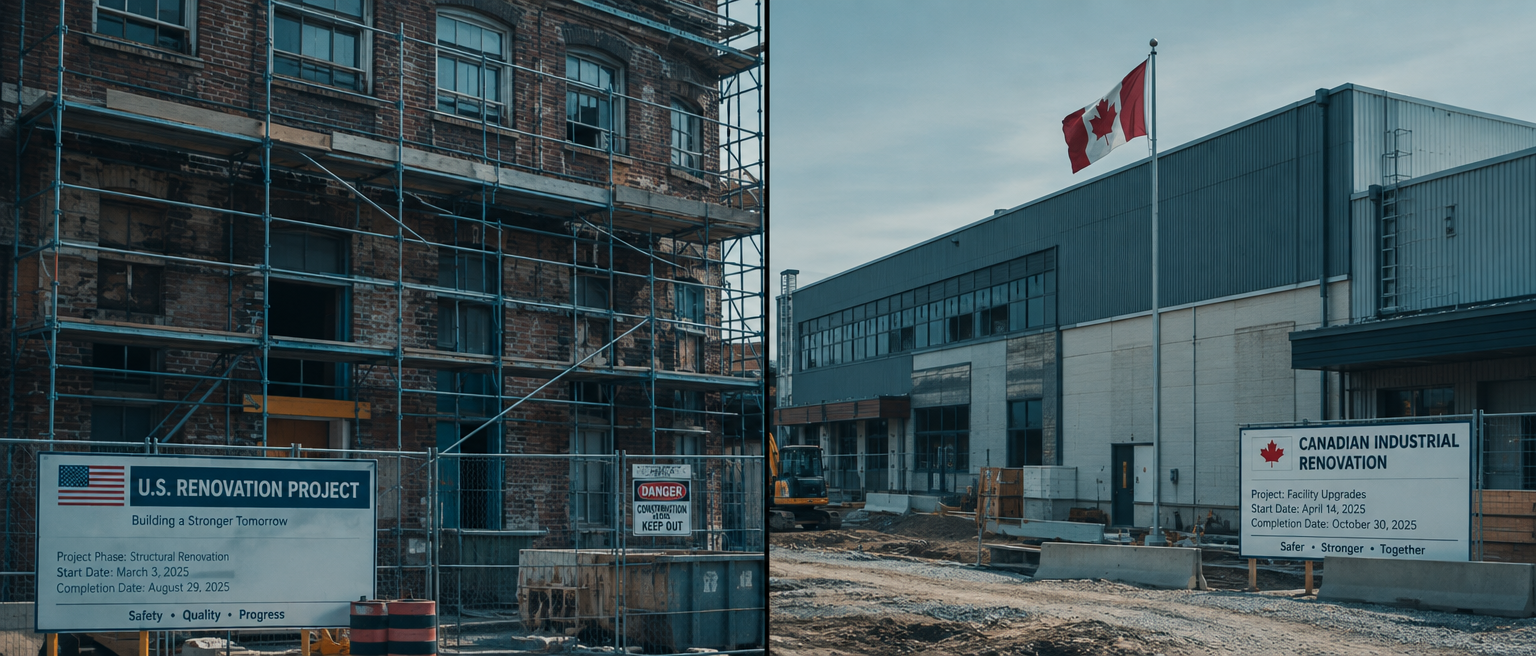
Same destination, two regulatory paths
Both countries have arrived at essentially the same place — a ban on new use of asbestos. Canada did it in one comprehensive law; the U.S. built toward the same outcome gradually.
A ban built step by step
The U.S. has also substantially banned asbestos, though through a different path than Canada's single 2018 regulation. According to EPA, specific uses were banned incrementally starting in 1973, followed by a partial ban in 1989, a 2019 rule preventing discontinued products from returning to market, and finally, in March 2024, a rule banning ongoing uses of chrysotile asbestos — the only form still legally imported, processed, and distributed in the U.S. at that time.
A ban in a single law
Canada reached the same place in one step: as of December 2018, the import, sale, and use of asbestos and asbestos-containing products is prohibited nationally, with limited exclusions — according to the Canada Gazette, publishing Canada's Prohibition of Asbestos and Asbestos Products Regulations.
The legacy neither ban removes
Both bans stop new use of asbestos. Neither removes the material that decades of use left installed in existing buildings on both sides of the border. That legacy still has to be identified before it is disturbed, handled safely while it is, and eventually removed — and according to OSHA, it is exactly that work, the disturbance of materials installed decades ago, where the heaviest asbestos exposures now occur.
Safe removal starts with knowing what is there — which materials, in what condition, in which locations — before anything is disturbed. That is the survey's job, and the data it leaves behind is what makes removal both safe to carry out and possible to prove. Decades of installed history do not age out of the record; they are the reason it exists.
Section 03
The Human and Economic Toll
Mortality and claims data from both countries, in the plain register the agencies themselves use.
malignant mesothelioma deaths, 1999–2005
CDC's mortality analysis recorded 18,068 malignant mesothelioma deaths in the U.S. from 1999–2005, with an annual death rate holding around 14 per million population, predominantly linked to occupational exposure, according to CDC's National Institute for Occupational Safety and Health (NIOSH).
Source: CDC's National Institute for Occupational Safety and Health (NIOSH)
Canada
accepted fatality claims tied to asbestos-related injury or disease, 1996–2014
Canada's federal regulatory impact analysis reports about 5,600 accepted fatality claims between 1996 and 2014 — about 400 in 2014 alone — and that roughly 70% of all compensated Canadian occupational-disease death claims between 1997 and 2010 were attributed to asbestos exposure. Source: the Canada Gazette, publishing Canada's Prohibition of Asbestos and Asbestos Products Regulations.
lung cancers per year
mesotheliomas per year
estimated annual cost
Occupational asbestos exposure causes an estimated 1,900 lung cancers and 430 mesotheliomas annually in Canada — about 8% of all lung cancers and 81% of all mesotheliomas diagnosed in the country each year — at an estimated annual cost of approximately $2.35 billion, according to CAREX Canada, via the Occupational Cancer Research Centre.
Section 04 · The building-age myth
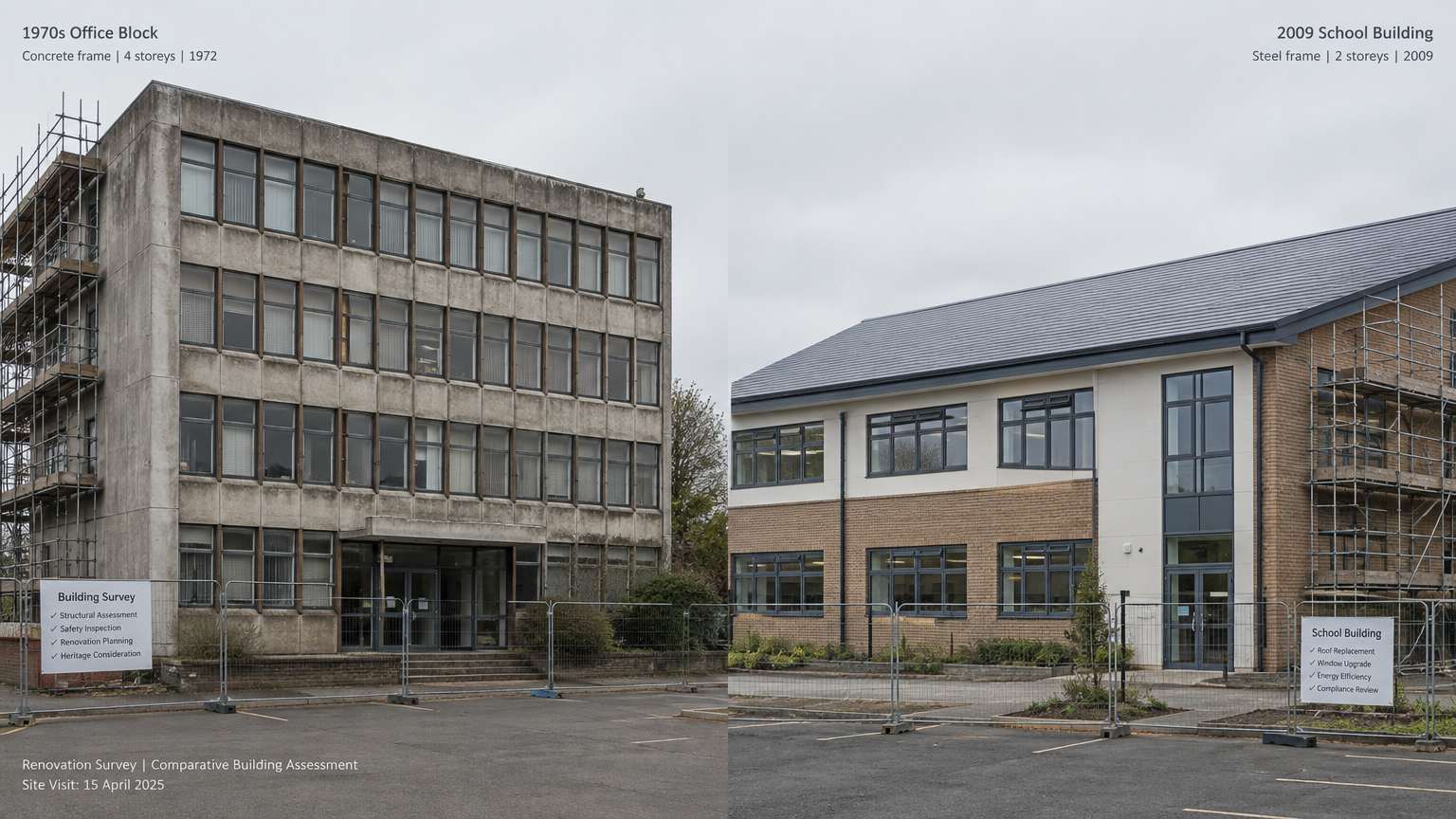
The Danger of Assumption: no building is too new to survey.
The belief that asbestos is only a problem in old buildings persists on both sides of the border — and regulators still have to actively correct it. In the U.S., the EPA's Asbestos NESHAP regulation requires a thorough asbestos survey before any renovation or demolition, with no exemption based on the age of the building, according to the Santa Barbara County Air Pollution Control District, delegated by the EPA to enforce the Asbestos NESHAP.
The point is not theoretical. Environmental consulting firm Fuss & O'Neill documents a school built in 2009 that was found to contain asbestos in its roof tar during a required pre-renovation survey — a building many would assume is far too new to contain asbestos.
The rule that follows
No building's age — and no country's ban date — makes a structure exempt from needing its existing materials identified before disturbance. Canada's 2018 prohibition applies to the import, sale, and use of asbestos; it does not remove the asbestos already installed in existing buildings. In both countries, the materials that matter are the ones already there, whatever year the building was built.
Section 05
Why the Record Has to Outlive the Renovation
Asbestos-related disease surfaces decades after the exposure that caused it. The survey record is what has to survive that gap.
In a major occupational cohort study cited by OSHA, all pleural and peritoneal cancer deaths occurred 30 or more years after first exposure. CDC's National Institute for Occupational Safety and Health (NIOSH) notes that most mesothelioma deaths trace back 20 to 40 years, and that new cases can still result from occupational exposure during maintenance, demolition, or remediation if controls are insufficient.
The same pattern holds in Canada. CAREX Canada, via the Occupational Cancer Research Centre, notes that most asbestos-related disease diagnosed in Canada today reflects exposure that occurred well before the 2018 ban — consistent with the same multi-decade latency period.
The pivot for survey practice
Because disease can surface decades after the work is done, the only thing that can later prove what was tested, when, and with what result is the record itself — not memory, and not the fact that a ban or regulation existed at the time.
Exposure to disease onset: the gap a record has to survive
Sources: CDC's National Institute for Occupational Safety and Health (NIOSH); OSHA. Illustrative axis — marker positions reflect the reported ranges, not individual cases.
Section 06
From a Single Survey to a Defensible Record
An undocumented 'we checked' is a claim. A structured, sample-by-sample record is evidence.
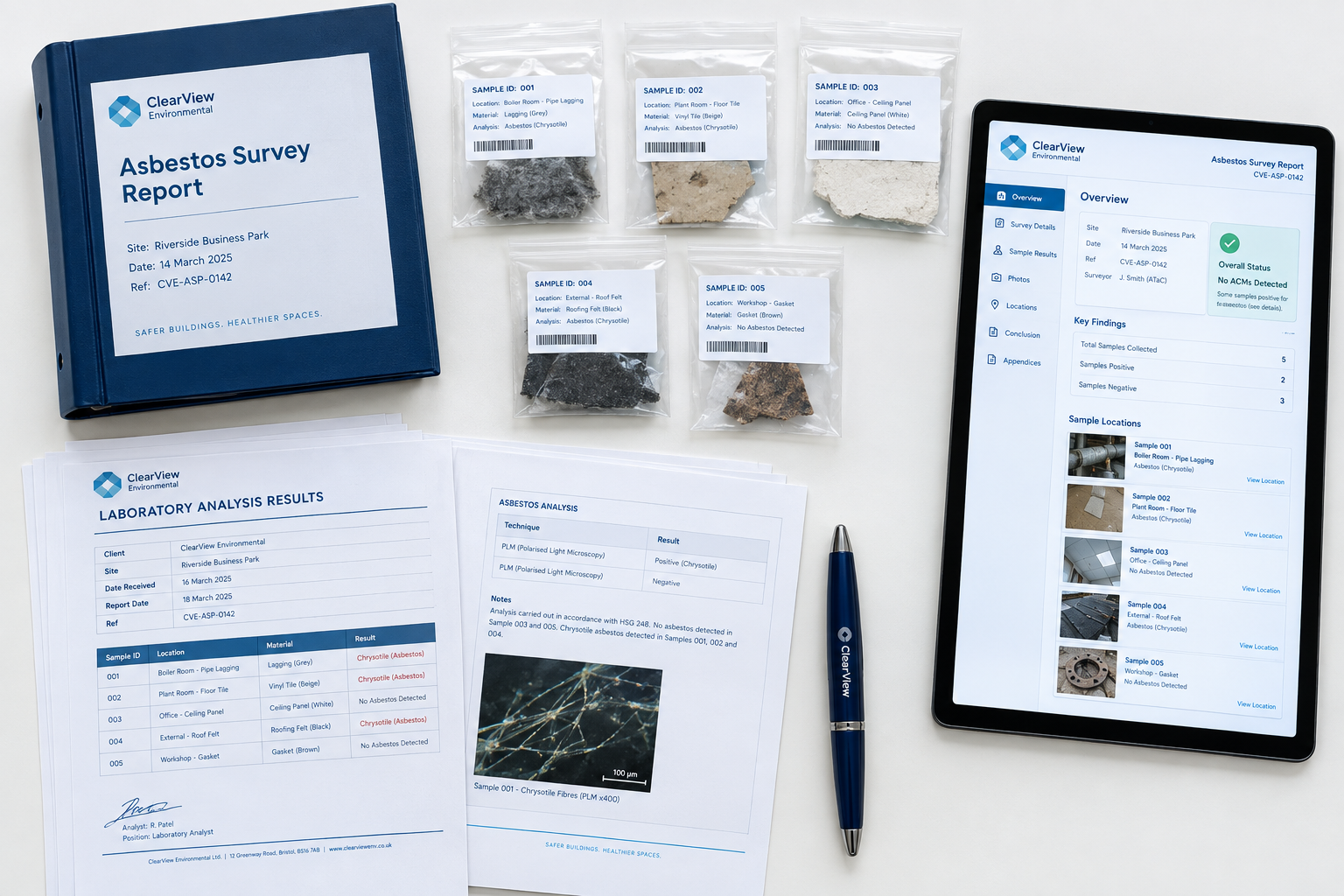
An undocumented "we checked" doesn't hold up years or decades later — when the crew that did the work has moved on, the consultant has retired, and the building has changed hands twice. What holds up is a structured, sample-by-sample record, tied to homogeneous areas, photos, and lab results.
That record is what turns a survey from a one-time task into evidence that can be produced on demand: what was sampled, where it came from, who handled it, what the laboratory found, and what condition the material was in at the time. If any link in that chain lives only in someone's memory or one person's files, it isn't a record — it's an assertion.
Section 07
What a Defensible Survey Program Requires
Four principles, drawn from the regulatory record above, that apply on both sides of the border.
01
Survey completely before any disturbance, regardless of assumptions
Neither a building's age nor a jurisdiction's ban date exempts a structure from having its existing materials identified before work begins.
The specific requirements are set locally. In the U.S., OSHA sets federal exposure standards while individual states may run their own OSHA-approved occupational safety programs. In Canada, the federal ban — published in the Canada Gazette, publishing Canada's Prohibition of Asbestos and Asbestos Products Regulations — sits alongside provincial and territorial occupational health and safety authorities, which regulate how legacy asbestos already inside existing buildings is identified, managed, and disturbed. The exact rule to check is a local one.
02
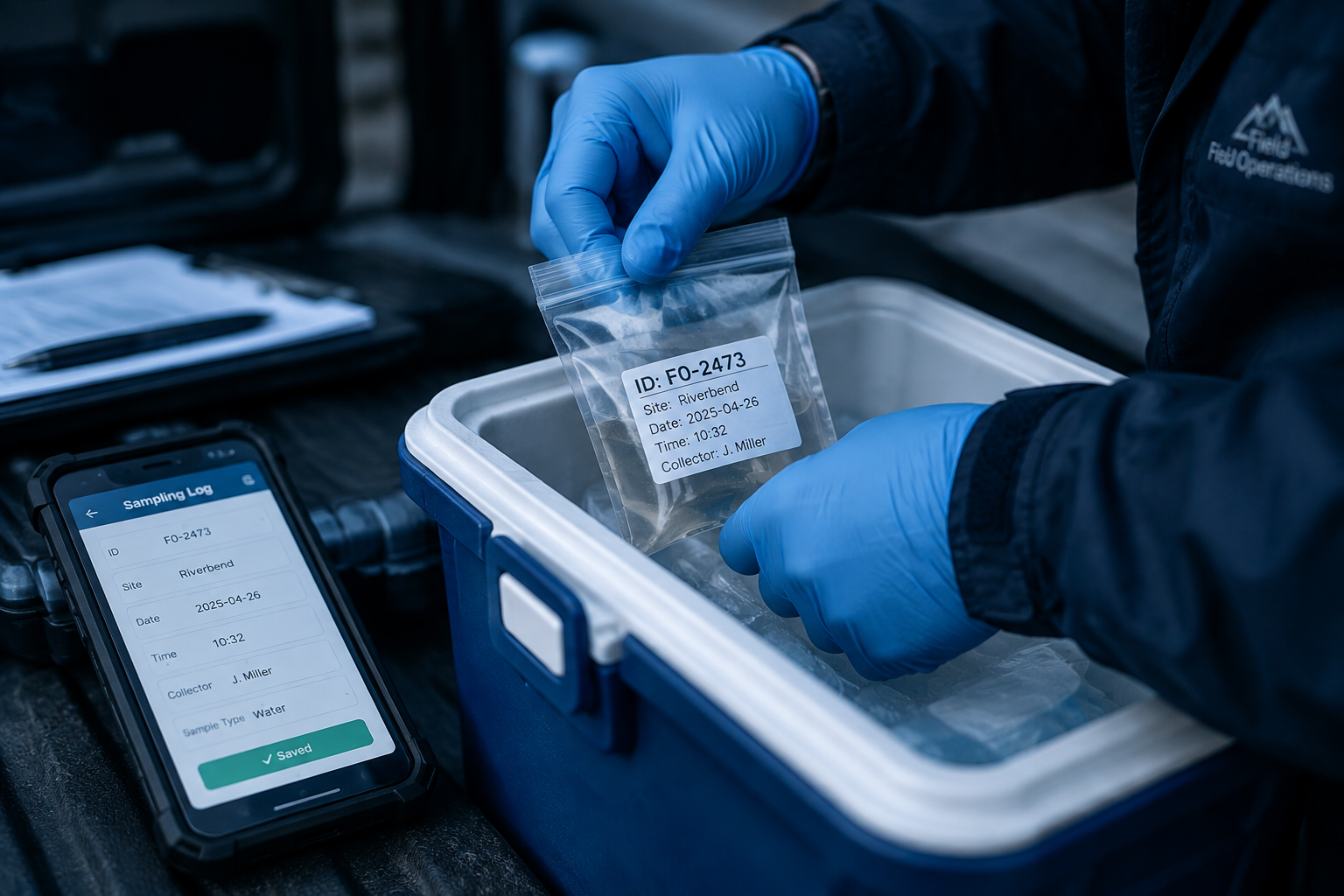
Document a chain of custody from bagged sample to lab result to final report
Every sample should be traceable end to end: who collected it, when, from which material, which lab analyzed it, and what came back. A gap in that chain is a gap in the record's evidentiary value.
03
Tie each material to a specific, verifiable location and photo
Not a general description — a location a third party can find again, with a photograph tied to the sample. 'Second-floor mechanical room' is a description; a sample ID, a homogeneous area, and a photo are proof.
04
Keep records the whole firm can produce on demand, even decades later
If the record lives in one person's files, it retires when they do. Duty holders need records that outlive staff turnover, business transfers, and the decades-long gap between exposure and disease onset.
Section 08
How aQRate Fits In
aQRate is a field data collection and inspection-management platform. Each principle above maps to a specific capability.
01
Survey completely before any disturbance
No-code form builder and offline mobile capture
Design the survey form your jurisdiction requires — nested sections, required fields, GPS pins, signatures — and let crews complete it on site with no signal, syncing automatically when connection returns. No assumption is ever recorded in place of a sample.
02
Documented chain of custody
Structured sample records with lab-result mapping
Follow each sample from field collection through lab results inside the same record, so the chain from bagged sample to final report is continuous and auditable.
03
Verifiable material-to-location proof
Timestamped, geotagged photos locked to each sample record
Each sample carries its own photo evidence — time and location attached, tied to the sample ID and homogeneous area — so every material is traceable to a specific, findable location.
04
Records the whole firm can produce on demand
Shared web portal with exportable reports and registers
Submissions, reports, and asbestos registers live in one shared portal the whole firm — or the duty holder — can access and export decades later, not in one person's files.
See how aQRate supports a defensible survey program
The dedicated page covers the asbestos inspection workflow in detail — forms, sample tracking, lab results, and report generation.
Further reading: how one team cut hazmat survey data handling by 60%
Section 09
The Asbestos Inspections Starter Template
A ready-made aQRate workspace with the Asbestos Bulk Sampling Log form, the Asbestos Report Template, and the Asbestos Inspection Dashboard — with seven sample records to explore.
Asbestos Bulk Sampling Log
Sample ID*
Material Description*
Sampling Date*
Sampling Time*
Sample Location*
Homogenous Area*
Condition*
Damage Category*
Friable*
Quantity*
Sample Picture*
Sub Part
Asbestos Bulk Sampling Log
MM-03-06
White Mudding Compound
2026-09-17
06:07
Stable#2 Interior Walls
HA-3
Damaged
(4) MM - Damaged or Sig. Damaged
Yes
35 Sqft
Photo captured
—
Report ready: Asbestos Report Template
Section 10
Frequently Asked Questions
The questions environmental consultants, inspectors, and facility managers ask most — answered from the regulatory record.
In the U.S., the EPA's Asbestos NESHAP regulation requires a thorough asbestos survey before any renovation or demolition, with no exemption based on the age of the building, according to the Santa Barbara County Air Pollution Control District, delegated by the EPA to enforce the Asbestos NESHAP. Environmental consulting firm Fuss & O'Neill documents a school built in 2009 that was found to contain asbestos in its roof tar during a required pre-renovation survey. In Canada, the 2018 prohibition applies to new import, sale, and use — it does not remove asbestos already installed in existing buildings, whatever their age. On both sides of the border, the materials that matter are the ones already there.
No. According to OSHA, there is no safe level of asbestos exposure for any fiber type, and exposures as short as a few days have caused mesothelioma in documented cases. OSHA's permissible exposure limit has been progressively tightened as evidence accumulated — from 12 fibers per cubic centimeter when first set in 1971 to today's 0.1 — a reduction of more than 100-fold across five decades.
Both countries have banned new use of asbestos — by different paths. Canada did it in one comprehensive law: as of December 2018, the import, sale, and use of asbestos and asbestos-containing products is prohibited nationally, with limited exclusions, according to the Canada Gazette, publishing Canada's Prohibition of Asbestos and Asbestos Products Regulations. The U.S. built toward the same outcome gradually: according to EPA, specific uses were banned incrementally starting in 1973, followed by a partial ban in 1989, a 2019 rule preventing discontinued products from returning to market, and, in March 2024, a rule banning ongoing uses of chrysotile asbestos — the last form still legally used in the U.S. Separately, OSHA sets federal exposure standards — with individual states also running their own OSHA-approved occupational safety programs — and has progressively tightened the permissible exposure limit to 0.1 fibers per cubic centimeter. In both countries, the day-to-day rules for identifying, managing, and disturbing legacy asbestos in existing buildings are set by state, provincial, or territorial authorities.
Because disease can surface decades after the work is done, the only thing that can later prove what was tested, when, and with what result is the record itself — not memory, and not the fact that a ban or regulation existed at the time. An undocumented 'we checked' doesn't hold up years later; a structured, sample-by-sample record tied to homogeneous areas, photos, and lab results can be produced on demand.
Section 11
Sources
01
CDC's National Institute for Occupational Safety and Health (NIOSH)Malignant mesothelioma mortality and ongoing exposure surveillance (MMWR).
02
OSHA — Asbestos, Safety and Health TopicsNo safe level of exposure; exposure concentrated in renovation, repair, and demolition; state-plan structure.
03
OSHA — Federal Register, August 10, 1994Permissible exposure limit rulemaking: 12 f/cc (1971), down to 5, 2, and today's 0.1 f/cc.
04
OSHA — Asbestos HazardsOccupational cohort study: all pleural and peritoneal cancer deaths occurred 30 or more years after first exposure.
05
EPAU.S. asbestos bans by rule: specific uses banned incrementally starting in 1973, a partial ban in 1989, a 2019 rule preventing discontinued products from returning to market, and the March 2024 rule banning ongoing uses of chrysotile asbestos.
06
the Canada Gazette, publishing Canada's Prohibition of Asbestos and Asbestos Products Regulations2018 national prohibition; federal regulatory impact analysis: ~5,600 accepted fatality claims (1996–2014), ~400 in 2014 alone, ~70% of compensated occupational-disease death claims (1997–2010).
07
CAREX Canada, via the Occupational Cancer Research Centre~152,000 workers currently exposed in Canada; ~1,900 lung cancers and 430 mesotheliomas annually (~8% and 81% of annual diagnoses), ~$2.35 billion annual cost; disease today reflects pre-2018 exposure.
08
environmental consulting firm Fuss & O'NeillSchool built in 2009 found to contain asbestos in its roof tar during a required pre-renovation survey.
09
the Santa Barbara County Air Pollution Control District, delegated by the EPA to enforce the Asbestos NESHAPNESHAP survey requirement before renovation or demolition, with no exemption based on building age.